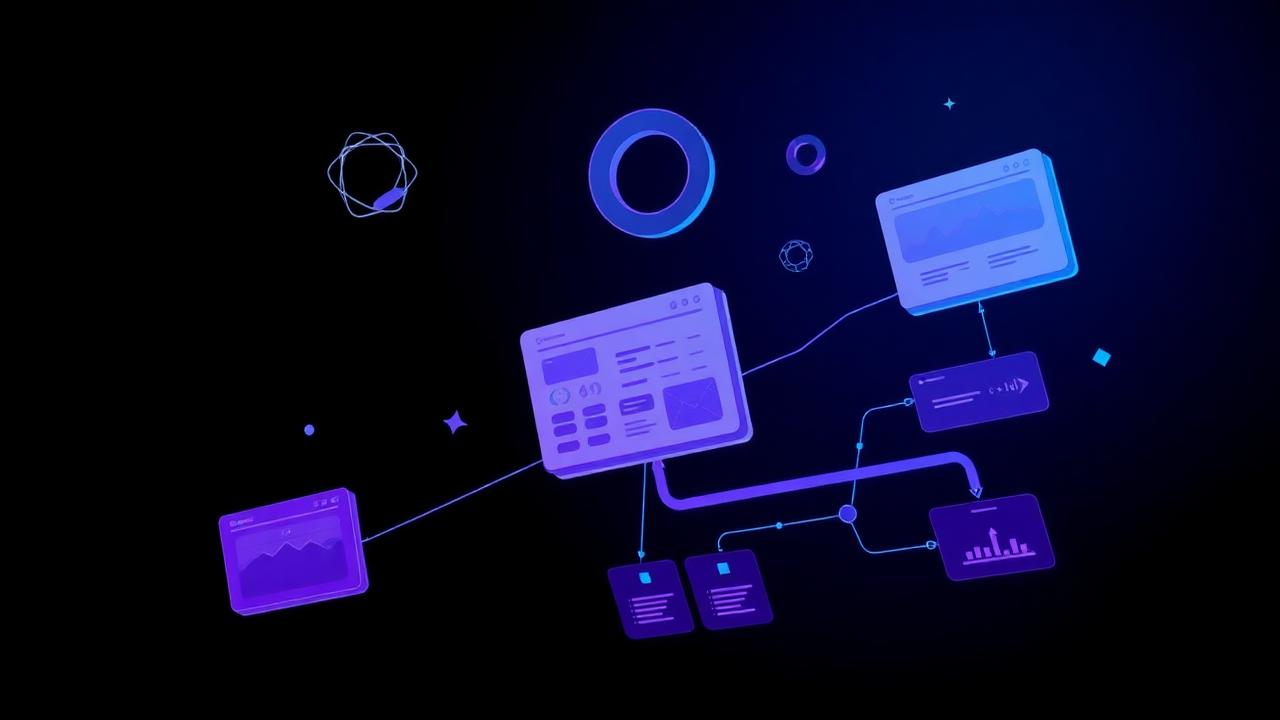
Most businesses start their automation journey with a single workflow: maybe a Zapier integration that sends Slack notifications when a form is submitted, or a Make.com scenario that syncs contacts between two platforms. These individual automations work fine in isolation - but they don't scale.
The problem is architectural. Isolated automations create data silos, introduce maintenance overhead, and break when business processes change. What starts as a simple integration becomes a tangled web of disconnected workflows that nobody fully understands.
From Workflows to Ecosystems
The solution is thinking in ecosystems, not individual automations. An automation ecosystem is a unified system where every workflow is aware of and connected to the others. Data flows through a central nervous system, and changes in one area automatically propagate to the rest. This is the foundation of the AI-powered operations model we describe in why AI automation is the future of business operations.
Why n8n Is Our Platform of Choice
n8n gives us full control over the infrastructure, allows self-hosting for data-sensitive clients, and provides the flexibility to build complex multi-step workflows with custom logic. Combined with AI nodes that can call Claude or OpenAI, n8n becomes a platform for building intelligent operational infrastructure rather than glue between SaaS tools.
What we get from n8n that closed platforms can't match
- Self-hosting for sensitive data, with no per-task pricing surprises
- Native code nodes for custom logic that doesn't fit the visual builder
- Version control, environments, and proper deployment workflows
- First-class AI integration - Claude, OpenAI, embeddings, vector stores
- A growing ecosystem of community nodes for niche tools
What a Mature Ecosystem Includes
A typical ecosystem we build at Clixo AI includes a lead capture pipeline that qualifies and routes prospects using AI, a client onboarding system that triggers document collection and account setup, automated reporting that aggregates data from multiple tools into unified dashboards, internal AI assistants that help teams retrieve information through natural language, and the kind of voice and chat agents we describe in our piece on AI voice agents.
For role-specific examples of these patterns, see how they apply to real estate teams and marketing agencies.
The Single Source of Truth
An ecosystem only works if every workflow shares the same understanding of customers, deals, and operational state. That's why CRM integration sits at the center of every Clixo build. When the CRM is the source of truth, every other workflow becomes simpler, more reliable, and easier to maintain.
Maintainability Is the Real Win
When a new tool is added to the stack, it plugs into the existing ecosystem rather than requiring a separate set of automations. When a process changes, you update one workflow instead of fifteen. The result is operational infrastructure that behaves more like software than a collection of integrations - maintainable, scalable, and observable.
Where to Start
Building an ecosystem requires upfront architectural thinking, but the long-term payoff is massive: less maintenance, fewer errors, and operations that scale without adding headcount. The best starting point is an automation audit that maps your current workflows and identifies the highest-leverage starting points. If you'd like us to run that audit for you, book a call and we'll walk through your stack together.