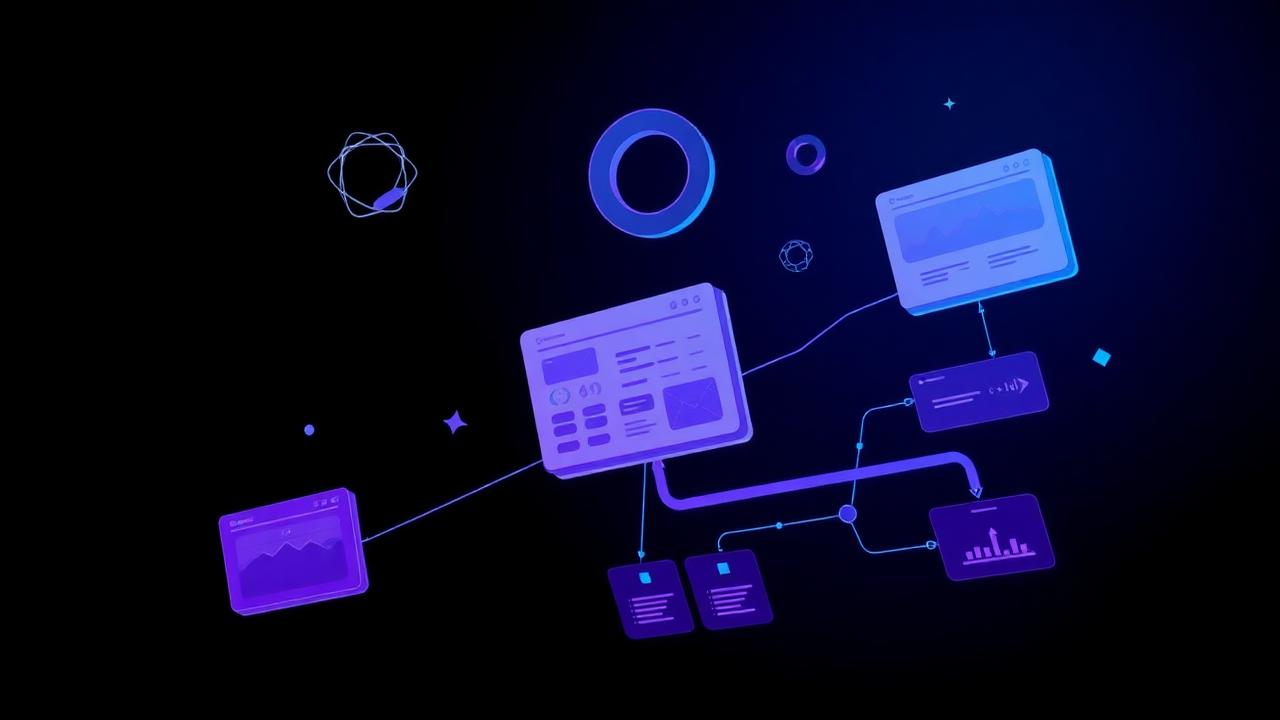
Every growing business hits the same wall: the processes that worked at ten employees collapse at fifty. Lead follow-ups get missed, client onboarding takes too long, and teams spend hours every week on tasks that add zero strategic value. This isn't a people problem - it's an infrastructure problem, and it's one that AI automation is uniquely positioned to solve.
AI-powered automation replaces repetitive manual workflows with intelligent systems that execute tasks consistently and at scale. Unlike traditional automation that follows rigid if-then rules, AI automation can interpret data, make decisions, and adapt to context. It's the same shift we wrote about in our deep-dive on LLMs and workflow automation - turning what used to require human judgment into something a machine handles in seconds.
The Real Cost of Manual Operations
Most leaders dramatically underestimate the operational tax of manual work. It's not just the obvious tasks - the data entry, the copy-pasting, the back-and-forth emails. It's the cognitive switching cost. It's the errors that compound downstream. It's the talented people who quit because they're stuck doing work a machine should be doing.
When we audit a typical mid-market operation, we usually find 30–50% of working hours absorbed by tasks that could be fully or partially automated. We break down the math in calculating the real ROI of business automation, but the headline number is consistent: every $100k of fully-loaded salary tied to manual ops is roughly $30–50k of recoverable margin.
What AI Automation Actually Looks Like
Consider lead qualification. A traditional automation might route every form submission to the same inbox. An AI-powered system can analyze the submission, score the lead based on historical conversion data, enrich it with firmographic information, and route it to the right salesperson - all before a human even sees it. The same logic applies to client onboarding, support triage, proposal drafting, and reporting.
The three layers of an AI automation
- Trigger layer - a form, an email, a CRM event, or a scheduled job kicks the workflow off.
- Reasoning layer - an LLM interprets unstructured inputs, classifies them, and decides the next action.
- Execution layer - workflow tools like n8n, Make, or Zapier carry out the action across your stack.
This three-layer pattern is the foundation of every system we build. We go deeper into the architecture in building scalable automation ecosystems with n8n and AI.
Where the Compounding Returns Come From
The impact of AI automation compounds over time. In quarter one, you reclaim hours. In quarter two, you reduce error rates. By quarter three, your team is operating at a level that would otherwise require two or three additional hires. Businesses implementing AI automation typically see a 40–60% reduction in operational overhead within the first year - not by cutting people, but by giving them infrastructure that lets them focus on the work that actually moves the business forward.
For industry-specific examples of these returns, see how we approach real estate operations and marketing agencies scaling without headcount.
The Strategic Imperative
The companies that will dominate the next decade aren't the ones with the most employees - they're the ones with the most intelligent operational infrastructure. AI automation isn't a nice-to-have anymore. It's the foundation of scalable business operations, and the gap between companies that have it and companies that don't is widening every quarter.
At Clixo AI, we help businesses make this transition by auditing existing workflows, identifying high-impact opportunities, and building systems that grow with them. The result is an operation that runs faster, costs less, and scales without friction. If you're ready to see what that could look like in your business, book a free 30-minute call and we'll walk you through it.